
DATACC BY DIME PROJECT


Identify where digital measures capture day-to-day patterns in sleep, activity, and daily routines between visits.

Document what digital measures can and cannot support today. Use them today to complement clinician‑ and patient‑reported assessments. Some digital measures may eventually replace specific patient‑reported outcomes (PROs) and clinician‑reported outcomes (ClinROs) once they are qualified for that context of use, but that is not the role for most CMHD trials today.

Align digital endpoint choices with your CMHD study questions.

Pre-specify how you will handle missing data, gaps in wear time, and encourage adherence. DiMe’s sDHT Navigator includes a section on risk-based approaches for trial monitoring.
Endpoint strategies you can use now
Each strategy below uses the same structure to help you determine when to use an endpoint, why it helps, and an example of how to use it.
 Strategy 1: Add real-world, continuous, and objective data
WHEN TO USE:
COA scores lack the sensitivity to capture day‑to‑day fluctuations in routines, sleep, physical activity, emotions, social interactions, or meaningful activities that you need to show clinical benefit in CMHD trials.
WHY IT MATTERS:
Meaningful aspects of health (MAH), such as those found in the conceptual model, can help you operationalize what matters most to patients, consistent with FDA’s Patient-Focused Drug Development (PFDD) guidance and DiMe’s Measures that Matter framework, strengthening your patient-centered evidence base the FDA increasingly expects in CMHD trial submissions.
 In a 2024 real-world study of 49 patients with bipolar disorder, Anmella and colleagues used a wrist-worn wearable (Empatica E4) to continuously capture electrodermal activity (EDA) across mood episodes and clinical remission. They observed that both tonic (mEDA) and phasic (pEDA) EDA were significantly reduced during acute depressive episodes and rose after the patient reached euthymia, while manic patients showed reductions in both signals after remission. Because EDA is captured passively and continuously in patients’ daily environments, the change-from-baseline in these measures substantiates whether a patient’s self-reported mood status matches a measurable physiologic response, providing a promising objective complement to clinician- and patient-reported assessments in CMHD trials.
 Nightware, a 2020 FDA breakthrough device is actively being prescribed to people with post-traumatic stress disorder. It’s an Apple Watch app that monitors for the physiological patterns of a trauma-related nightmare. In a 2023 randomized sham-controlled trial of 65 military veterans with PTSD-related nightmares, participants who used the active NightWare device on more than 50% of nights experienced significantly greater improvements in sleep quality than sham users on the Pittsburgh Sleep Quality Index and NightWare Likert, along with greater reductions in sleep latency and nighttime disturbances. The device continuously adapted to each user by building an individualized “stress index” from approximately 1,000 minutes of prior sleep data, demonstrating how wearable-derived physiologic signals may serve as an objective complement to self-reported nightmare severity and PTSD-related sleep outcomes.
 Strategy 2: Track trajectories, not just snapshots
WHEN TO USE:
Visit-based assessments capture status at single time points but miss the trajectory and timing of change between visits, including how quickly symptoms recur, stabilize, or respond to treatment.
WHY IT MATTERS:
It captures trajectories between visits and can reveal patterns that self‑report misses, but only when you plan the analyses in advance and interpret them alongside clinical assessments.
DO NOT CLAIM:
That measuring more often automatically makes a trial better. Denser data only translates into stronger results when you understand how the measure behaves in your population, how patients’ experiences vary day to day, and have a clearly defined purpose for the data collection.
 In a 31-patient pilot of adults with major depressive disorder, Pedrelli and colleagues, tracked smartphone behavior (calls, texts, activity patterns, app use) and wrist-worn Empatica E4 sensor data (electrodermal activity, skin temperature, heart rate, motion, actigraphy-derived sleep) over 8 weeks of continuous monitoring, alongside the clinician-rated 17-item Hamilton Depression Rating Scale (HDRS-17) administered every two weeks. Machine learning models built on the wearable and smartphone features estimated depression severity with correlations of 0.5 (95% CI 0.45 to 0.55) against the clinician-rated HDRS, with mobile phone engagement, activity level, skin conductance, and heart rate variability emerging as the most predictive features. The study illustrates how a longitudinal behavioral summary derived from passive sensors can be tracked against a clinician-administered COA across time in a CMHD trial, complementing rather than replacing the rating-scale assessment.
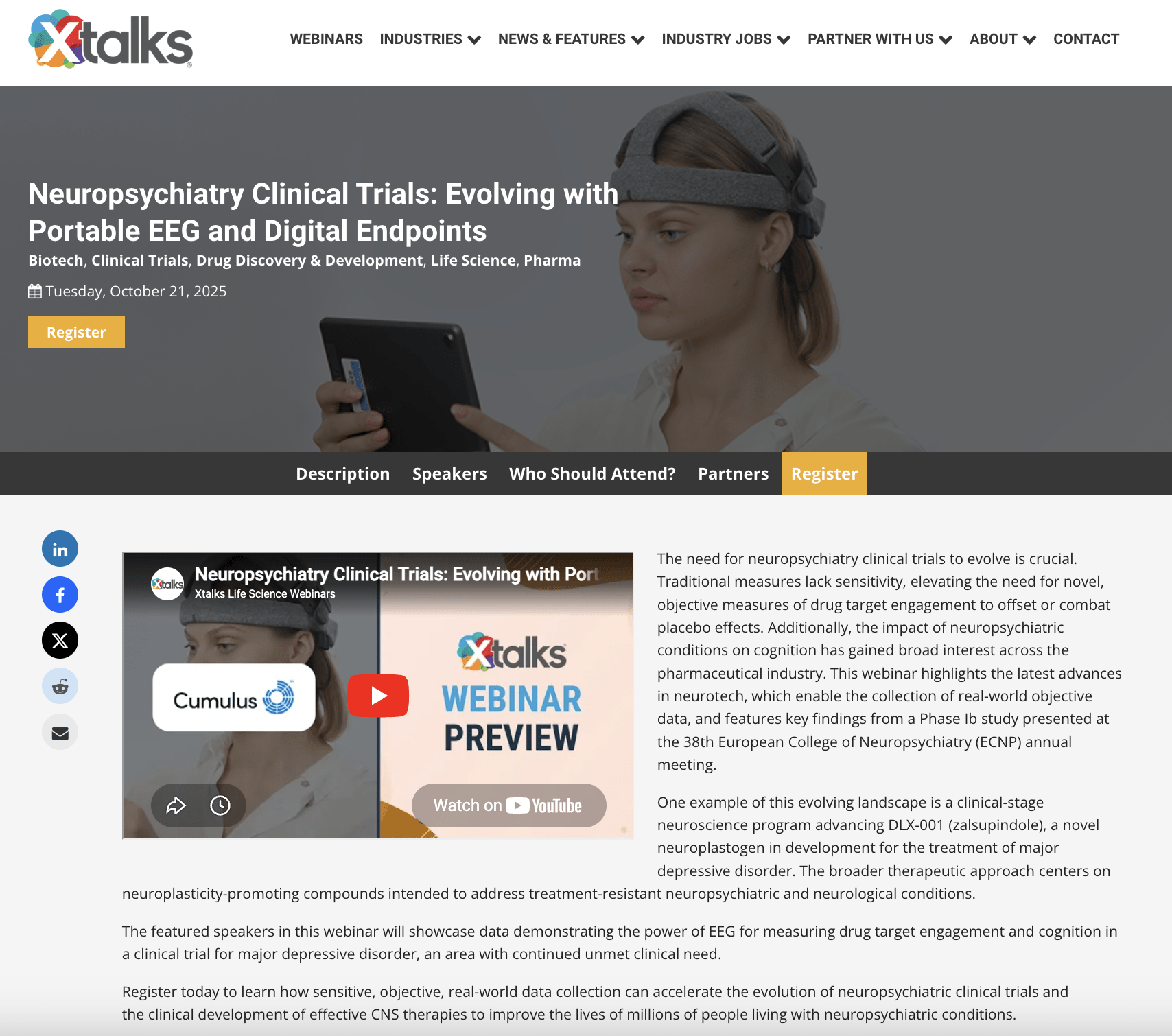 Delix Therapeutics has developed DLX-001 (zalsupindole), a novel oral non-hallucinogenic neuroplastogen inspired by 5-MeO-DMT (mebufotenin) for major depressive disorder (MDD). In the DLX-001 Phase 1b study (N= 18 adults with MDD), Delix leveraged the Cumulus Neuroscience NeuLogiq® Platform – an AI-based, multi- domain digital biomarker platform that pairs an FDA 510(k)-cleared dry sensor EEG headset with gamified tablet-based assessments across multiple domains of brain function. The use of NeuLogiq enabled repeated digital sampling of qEEG/ERP biomarkers, and cognitive safety endpoints, complementing conventional trial measures, including clinician-rated symptom scales (MADRS and HAM-D-17), PK, qEEG, PSG, and safety assessments. Across baseline, dosing, and follow-up, the platform collected 339 digital assessment sessions, combining dry-EEG tasks and brief cognitive assessments, with EEG-based sessions timed around expected peak drug exposure where feasible. This sampling design allowed analyses to examine acute, cumulative, cohort, and exposure effects adding temporal and mechanistic context beyond visit-level clinical outcomes. Resting-state qEEG analyses and task-based event related potential (ERP)ⓘ Event-related potentials (ERPs) are time-locked brain responses to specific events or stimuli. The NeuLogiq platform incorporates a patented technology to enable precise time-synchronization to the wireless headset. – analyses, including Auditory Steady-State Response (ASSR) readouts, captured individual-participant trajectories in neurophysiological signals relevant to DLX-001’s proposed neuroplasticity-related mechanism. This is particularly valuable in early-phase studies where there is a need to characterize drug mechanisms and within-participant change over time, in addition to clinical treatment outcomes. Repeated cognitive testing using the NeuLogiq Symbol Swap assessment – a gamified and validated version of the well-established digit symbol substitution test (DSST) – provided data showing typical patterns task learning, and no evidence of acute or delayed cognitive impairment related to the drug. The case illustrates how digital biomarkers can provide complementary information to traditional registered clinical trials endpoints by adding temporal resolution and mechanistic context, rather than replacing or serving as a direct comparator to clinician-administered assessments.
 Strategy 3: Explore subgroup or response patterns
WHEN TO USE:
You want to explore heterogeneity in longitudinal CMHD data, such as whether different individuals show distinct patterns of change in sleep and activity that co‑occur with symptom trajectories.
WHY IT MATTERS:
Supports stratification of heterogeneous CMHD populations and exploratory identification of subgroups more or less likely to benefit from a treatment, provided you plan analyses in advance, account for multiplicity and confounding, and use findings to inform future trial design rather than treatment decisions.
EXAMPLE:
 In a (prepublication) population-scale longitudinal analysis of patients on an SSRI, Headlamp Health used its Lumos AI platform to track response trajectories over time and identified four discrete responder clusters (high, partial, insufficient, and low responders). The high- and low-responder clusters shared the same top diagnoses, but differed in augmentation pattern: the difference associated with worsening from baseline came down to one augmentation choice (a CNS stimulant versus an amino ketone). Findings like these are best used to inform downstream prospective enrichment trials or pre-specified confirmatory subgroup analyses, not as rules for individual treatment decisions, and they illustrate the kind of heterogeneity that longitudinal CMHD data can surface when symptom trajectories and treatment patterns are modeled together.
Today, digital measures support exploratory and secondary endpoints in CMHD trials. To develop a primary endpoint, support real-time clinical alerts in routine care, drive individual treatment decisions, or carry labeling claims, the field still needs:
-
 Reproducible measure performance across diagnoses, severities, and care settings
 -
Qualification of the meaningful aspect of health, the measure, and the context of use as a triad for each specific decision context
-
Repeated demonstration of the value
-
Engagement and adherence patterns characterized in the populations the measure is intended to serve
-
Direct engagement with regulatory authorities to align on acceptable evidentiary standards before submission

